2026: Balancing Price Against seasonal timing — Retail Chain Focus
VapeWholesaleHub 2026 · 2026 trade programmes
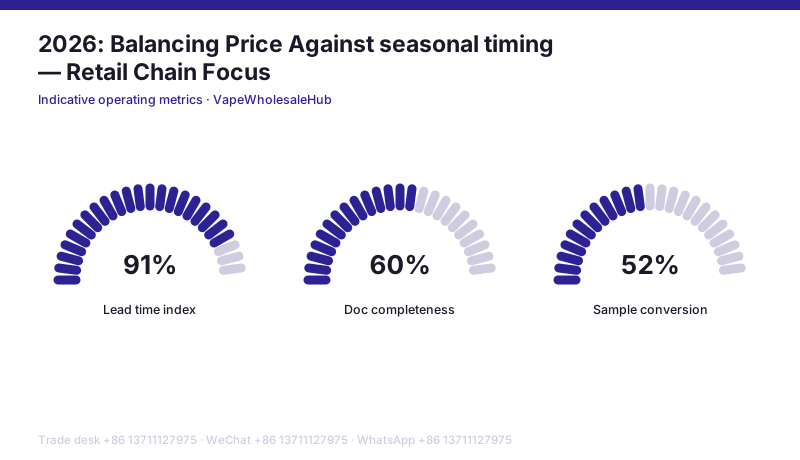
Buyers tend to discover the real cost of 2026: Balancing Price Against seasonal timing — Retail Chain Focus only after the first full quarter. That is usually when the pattern becomes visible: which lines turn quickly, which ones sit, and which supplier answers the phone. This page sets out the practical checks that make that first quarter cheaper.
Freight, packaging and landed cost
Logistics decides whether 2026: Balancing Price Against seasonal timing — Retail Chain Focus is profitable more often than product quality does. A three day saving on a freight route is worth more per unit than most price negotiations, and it is usually easier to achieve. Mode choice, consolidation and customs pre-clearance are where the margin actually lives.
Freight for 2026: Balancing Price Against seasonal timing — Retail Chain Focus has its own rhythm. Peak season rates, holiday closures and carrier capacity all move the landed cost in ways that a unit price sheet never shows. We plan replenishment backwards from the shelf date rather than forwards from the order date, and it removes most of the surprises.
Documentation and regulatory reality
Compliance is where 2026: Balancing Price Against seasonal timing — Retail Chain Focus either holds together or quietly falls apart. Regulators are not interested in intent; they want documents that match the physical goods. If the label says one thing and the test report says another, the shipment is the problem, not the paperwork.
Buyers sometimes treat compliance for 2026: Balancing Price Against seasonal timing — Retail Chain Focus as a cost to be minimised. It reads better as a moat. When the market tightens, the accounts that already hold complete technical files keep trading while everyone else scrambles to produce paperwork that should have existed a year earlier.
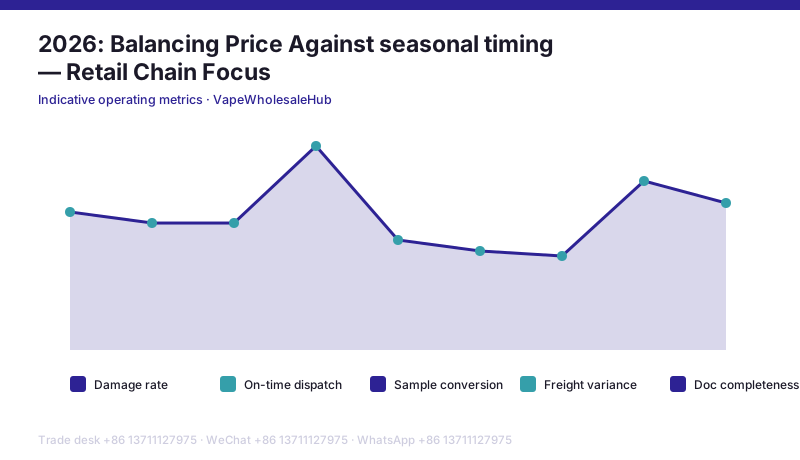
The commercial side of the decision
The accounts that grow steadily on 2026: Balancing Price Against seasonal timing — Retail Chain Focus tend to do one boring thing well: they reorder before they run out. It sounds obvious. In practice, most wholesale buyers reorder late, pay for expedited freight, and then blame the supplier for the cost.
Commercially, 2026: Balancing Price Against seasonal timing — Retail Chain Focus rewards buyers who think in turns rather than in unit cost. A slightly higher price on a line that sells through twice as fast is better money than a cheap line that occupies shelf space and working capital for two seasons.
Where the supply actually comes from
Sourcing decisions around 2026: Balancing Price Against seasonal timing — Retail Chain Focus are usually made on price and then regretted on consistency. The input changes, the tolerance drifts, and suddenly the line that sold through in March behaves differently in July. Locking the input specification in writing is the cheapest insurance a wholesale buyer can buy.
On the sourcing side, 2026: Balancing Price Against seasonal timing — Retail Chain Focus comes down to how much of the chain you can see. A trading desk that only ever talks to a sales rep is buying on faith. We prefer accounts that ask for the factory audit, the mixing records and the batch numbers, because that paperwork is what protects everyone when a shipment is questioned later.
Order structure at a glance
| Item | Standard | Volume | Programme |
|---|---|---|---|
| Typical order unit | Master carton | Pallet | Full container |
| Documentation | COA + SDS | COA + SDS + batch record | Full technical file |
| Lead time | 2-4 working days | 5-10 working days | 15-25 working days |
| Customisation | Label only | Label + closure + bottle | Full OEM / ODM |
| Sampling | Charged, credited on order | Included in development | Multi-round approval |
| Indicative MOQ | 1000 units | 5,000 units | 20,000 units |
| Development window | n/a | 3-5 working days | 3-5 + approval |
Common questions
What shelf life should we plan around?
Unopened e-liquid is typically stable for around two years when stored cool and away from direct light, and device batteries lose capacity on a similar curve. We print manufacture dates and batch codes on every unit so stock rotation is straightforward.
How long does a bulk order take to arrive?
Stock lines usually leave the warehouse within two to four working days, with transit depending on the mode you choose. Custom development runs on a longer clock: formulation, approval, production and testing before anything ships. We give a written schedule at order confirmation and flag slippage the day we see it.
How are samples handled?
Sample packs are charged at cost with the shipping borne by the buyer, and the amount is credited against your first bulk order. That keeps sampling serious and avoids the delays that come with an open-ended free sample programme.
Related reading
- 2026 and Minimum Advertised Pricing — Regional Depot Guide
- Why 2026 Matters in shelf placement — New Account Setup
- 2026 Vape Supply Notes 70
- 2026 and Damage Rate Benchmarks — Trade Buyer Briefing
- 2026 and Regional Warehousing Choices — Distributor Focus
- 2026 Vape Supply Notes 1492
Talk to the wholesale desk. Specifications, MOQ, stock and freight options for 2026: Balancing Price Against seasonal timing — Retail Chain Focus.
Phone +86 13711127975 · WeChat +86 13711127975 · WhatsApp +86 13711127975