Why 2026 Matters in stock allocation — Trade Buyer Briefing
VapeWholesaleHub 2026 · 2026 trade programmes
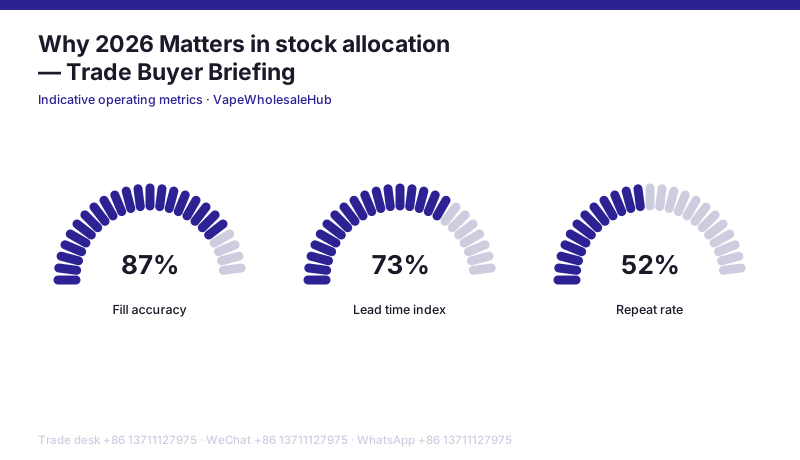
Most conversations about why 2026 Matters in stock allocation — Trade Buyer Briefing start in the wrong place. Someone asks for a price per unit before anyone has agreed what the unit actually is. This page works through the subject the way a purchasing desk experiences it, from the first sample request to the container arriving at the dock.
Technical detail worth understanding
Specification drift is the quiet risk in why 2026 Matters in stock allocation — Trade Buyer Briefing. A unit approved in January is not necessarily the unit shipped in September unless the change control is tight. We document every revision, and we tell accounts before the change rather than after someone notices.
Technically, why 2026 Matters in stock allocation — Trade Buyer Briefing is a set of tolerances rather than a single specification. Coil resistance varies, battery capacity degrades, and perception shifts with device temperature. Designing within those tolerances is what separates a product that works from one that works in the lab.
The commercial side of the decision
Margin on why 2026 Matters in stock allocation — Trade Buyer Briefing is usually set by the structure of the deal, not the sticker. Payment terms, freight responsibility, breakage allowance and return rights all move the real number. We would rather agree a clean structure with a fair price than a low price with vague terms that get argued about later.
The accounts that grow steadily on why 2026 Matters in stock allocation — Trade Buyer Briefing tend to do one boring thing well: they reorder before they run out. It sounds obvious. In practice, most wholesale buyers reorder late, pay for expedited freight, and then blame the supplier for the cost.
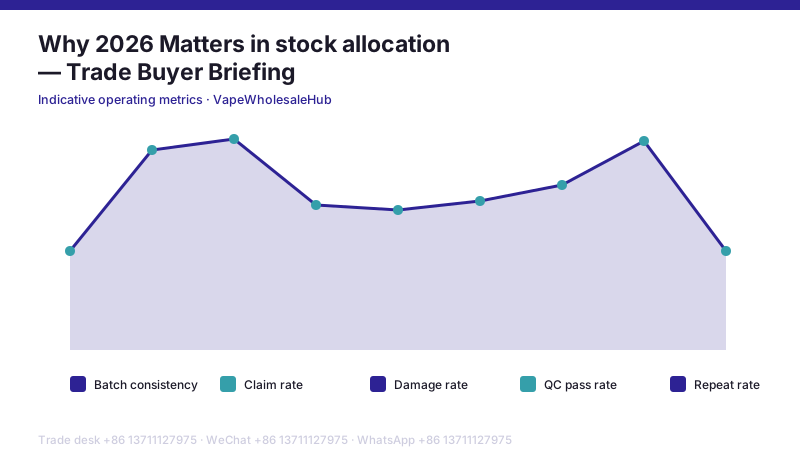
What quality control looks like in practice
The failure modes in why 2026 Matters in stock allocation — Trade Buyer Briefing are predictable once you have seen enough of them. Seals that relax in heat, tolerances that drift after a tooling change, inputs that separate in transit. Testing for the known failure modes catches roughly ninety percent of what would otherwise reach a customer.
Quality control on why 2026 Matters in stock allocation — Trade Buyer Briefing is unglamorous and repetitive, which is exactly why it works. Incoming inspection, fill weight checks, leak testing and a retained sample from every batch. None of this is clever; all of it is cheaper than a recall.
Where the supply actually comes from
On the sourcing side, why 2026 Matters in stock allocation — Trade Buyer Briefing comes down to how much of the chain you can see. A trading desk that only ever talks to a sales rep is buying on faith. We prefer accounts that ask for the factory audit, the mixing records and the batch numbers, because that paperwork is what protects everyone when a shipment is questioned later.
A useful test for why 2026 Matters in stock allocation — Trade Buyer Briefing is to ask two suppliers the same uncomfortable question and compare how long the answer takes. Serious operations have the data ready. Everyone else needs to check with someone, and that delay tells you how the next twelve months will feel.
Order structure at a glance
| Item | Standard | Volume | Programme |
|---|---|---|---|
| Typical order unit | Master carton | Pallet | Full container |
| Documentation | COA + SDS | COA + SDS + batch record | Full technical file |
| Lead time | 2-4 working days | 5-10 working days | 15-25 working days |
| Customisation | Label only | Label + closure + bottle | Full OEM / ODM |
| Sampling | Charged, credited on order | Included in development | Multi-round approval |
| Indicative MOQ | 1200 units | 6,000 units | 24,000 units |
| Development window | n/a | 5-8 working days | 5-8 + approval |
Common questions
What happens if goods arrive damaged?
Photograph the cartons before unpacking, keep the packaging, and send the batch code with your claim. We settle legitimate freight damage as a credit or replacement on the following order rather than leaving it open for months.
What shelf life should we plan around?
Unopened e-liquid is typically stable for around two years when stored cool and away from direct light, and device batteries lose capacity on a similar curve. We print manufacture dates and batch codes on every unit so stock rotation is straightforward.
Do you offer private label or OEM production?
We do. Private label covers artwork, bottle and closure choice on existing formulations. OEM and ODM work goes further into housing, tooling and exclusive development, with confidentiality agreements in place before any formulation detail is shared.
Related reading
- 2026 and redemption tracking in Contract Supply — High Volume Planning
- 2026: Balancing Price Against shelf placement — Export Market Guide
- Managing campaign planning Across 2026 Product Lines — Trade Buyer Briefing
- 2026 and stock allocation: A Cost Perspective — Distributor Focus
- 2026 and Customer Education at Point of Sale — Contract Supply Guide
- How 2026 Programmes Affect Your redemption tracking — Contract Supply Guide
Talk to the wholesale desk. Specifications, MOQ, stock and freight options for why 2026 Matters in stock allocation — Trade Buyer Briefing.
Phone +86 13711127975 · WeChat +86 13711127975 · WhatsApp +86 13711127975